Friday, March 2, 2012

Belize


We crossed the border at Melchior, Guatemala into Belize.  Within two hours we are in a completely different culture.  First of all, it’s English (and Creole).  I’m still speaking Spanish, have to get used to English again. There is a wide mix of people, black Caribbean, sounding more Jamaican than anything, ladinos, Chinese, Mennonites and lots of other church groups.  Even though Creole is “English”, I honestly can’t understand more than a few words that sound like English.  The architecture is different too with lots of ramshackle wooden houses up on stilts, not as much of the concrete block construction common in Guatemala.  At first I think it is more developed and “together” than Guatemala, but I soon learn it is also very third world with similar problems of poverty, violence and poor education and medical services.  The countryside is beautiful, lowland jungle heading towards the Caribbean coast.

People are friendly, though kind of gruff on the outside compared to the sweet Guatemalan locals.  Voices are loud, the energy is more boisterous (Caribbean?).

We arrived in Caye Caulker on Thursday afternoon.  Two hours on a bus and another hour on a bumpy water taxi.  We walked with all our stuff and finally found a place further down the beach with very basic cabins on the beach.  It’s less expensive than most places here, and it’s okay.

The beach isn’t really a beach, but I did dive in the ocean off the rickety dock.  The water is warm and clean, lots of little fishes swimming around, can’t wait to snorkel/dive here.  This is reputed to be one of the finest diving areas in the world, so we’re looking forward to three days here on the ocean.  We rented bicycles this evening, so we are “free to explore”.
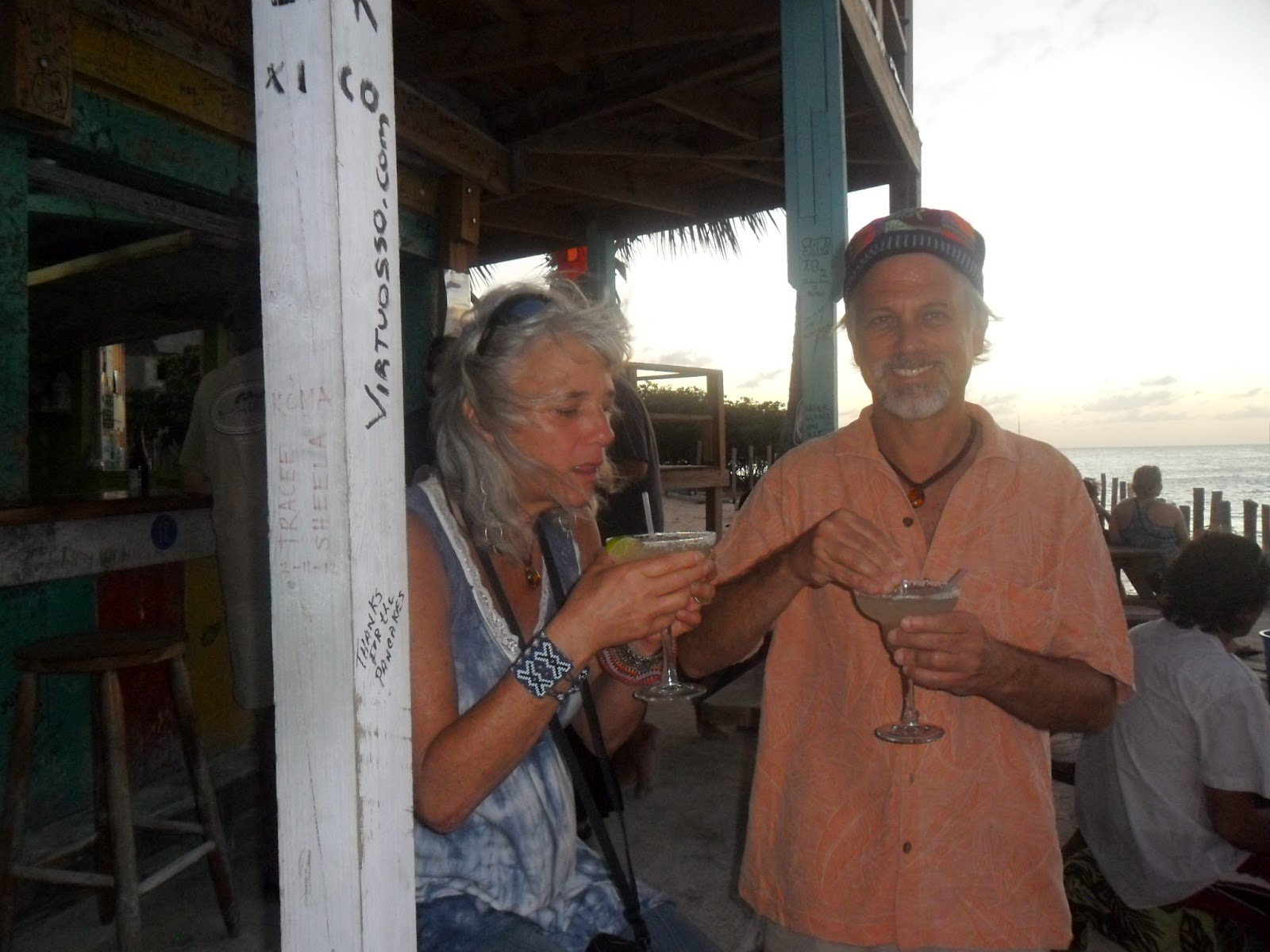
Margaritas at The Split - sundown
 After arranging bicycles, diving and snorkelling, we went to a spot called “The Split” to watch the sunset.  The Split is a place where there is a channel from one part of the island to the other.  There is a small sandy beach and lots of people hanging around and drinking.  We watched the red sun set over the ocean – another spectacular sunset, had margaritas, and hung out with some of the folks there.  Then we went up some back streets to a local restaurant, had conch fingers, salad and fried chicken.  I also had a rum drink with coconut and pineapple, which I later found out is called a Pantyripper (!).

We had a less than peaceful night in the cabin.  The wind is really strong right now, and we are out on the beach so it whistled through the walls and windows, and the big gusts would wake us up.  We may move after tonight to a more quiet spot off the beach.  We woke up this morning, Friday, and had breakfast then rode over to Frenchy’s dive shop.  Unfortunately, because of the heavy winds, diving is cancelled for the day.  We had planned to do a two-tank dive today, just chill tomorrow, then take a sailboat snorkelling tour on Sunday.  Now today is our chill day, and we are hoping the wind dies down for tomorrow.
A friend we met on our bicycle tour
Impressions of Caye Caulker, Belize.  Amy, we aren’t in Guatemala any more!  Such a different vibe, we have to adjust to the gruff style of the locals.  Service is not always with a smile, but once you talk to people, they brighten up and are fine.  Things are also more expensive here than in Guate, especially on the tourist strip.  We don’t see avocados here, where Guate was avocado heaven, but there are lots of nice tropical fruits, good vegetables, lots of fish and conch (no lobster right now), as well as meat, chicken, mutton and pork.

Amy and I on bikes - Caye Caulker
So we are praying for the wind to die down so we can dive tomorrow – this is why we came, after all.  Let’s hope.

Thursday, March 1, 2012

Leaving Guatemala

Our window at Pasaj-Cap


Music at Del Lago


Fire Ceremony Pasaj-Cap
We spent our last few days in Guatemala in El Remate.  It is a beautiful village on the edge of Lake Peten Itza, halfway between Flores and Tikal.  Our hotel, Casa Ernesto, is nestled in the jungle, and the lake is across the road.  We watched an incredible sunset and dipped our feet in the cool lake, as the symphony of voices rose as the sun went down.  Frogs, crickets, birds, even some howler monkeys created a swelling chorus.  Above, the almost half moon lined up with Jupiter and Venus.  Did you see that where you are?  Take a look in the western sky after sunset.


Lake Peten Itza, El Remate
El Remate is in the jungle lowlands in the northeast part of Guatemala.  When the sun sets, the banks of clouds look like mountains of white, blue, pink, orange and purple.  The lake is calm, ducks swimming nearby.  Our host Ernesto is out fishing for the Pescado Blanco found only here in Peten and parts of Mexico.  We ate his fish twice while we were here, absolutely delicious, fried with garlic!

Last night we celebrated the end of our time in Guatemala with a special dinner at a restaurant just down the road, called Las Orquideas.  An Italian menu, we had really good pizza (unusual in Guatemala, most of the pizza and cheese is boring), a big salad, wine, dessert (gelato with chocolate y crema) and good coffee.  Probably our most expensive meal in Guatemala, it was under $40.

Tikal Temple at sunrise
I have loved our time in Peten.  We visited the Mayan ruins in Tikal, a national park in the jungle.  The Tikal site itself is huge, you could walk more than 10 km to cover it, and we spent close to seven hours there, from 6:30 am to 2 pm.  At the site of the Seven Temples, both Amy and I lay back on the steps of one of the temples, and fell asleep for a half hour.  Imagine – sleeping with the Mayan kings!  The ruins are hundreds of feet tall and awesome, and the jungle life is teeming with bird sounds and sights, pizotes (like small raccoons), ocelated turkeys (they look like a mix of turkey and peacock, absolutely beautiful), monkeys (I heard them but didn’t see any), and other life forms.  The trees are remarkable too, and when we climbed above them at Templo IV, we could see over the whole site, with ruins popping through the trees in many directions.  Amazing!

On top of Templo IV, Tikal
I swam in the lake twice, warmer than Atitlan (probably cleaner too!).  Our cabin in the woods was private, in a beautiful spot with hammocks on the porch.  Despite what I have heard, there were few mosquitos, no problem this time of year.  We did see a big scorpion crawling on the porch under my hammock, and of course lots of spiders and such.  The weather was fine, very quickly changing, from sunny to suddenly cloudy and windy to rain to mist in the morning.  When the sun is out it gets quite hot, and I can only imagine the temperatures and humidity during the hot rainy season around May – June.

So now we’ve taken the bus into Belize, saying goodbye (for now) to the wonderful Guatemala.  We arrived in San Ignacio, just a few minutes over the border, and booked a room for the night.  We spent the afternoon with Sarah, the sister of our Phil’s partner Karen, and we had a wonderful lunch together, and then went on a tour of the twin towns of San Ignacio and Santa Elena, where Sarah lives.  The countryside is beautiful, with two rivers snaking through the region.  There is a big river canoe race happening in a week or so, where more than a hundred canoes paddle for four days down the river from here to Belize City.  We will spend the evening with Sarah as well, have dinner, and get ready for our trip to the ocean and diving tomorrow.

Tuesday, February 14, 2012

Time Winds Down in Guatemala


I am reflecting on my experience in Guatemala, as our time winds down here.  I feel a deep connection to this place, especially El Lago Atitlan.  Not only is it one of the most beautiful places I have been in the world, there is a powerful spiritual energy I feel here, combining the power of the lake and volcanoes with the spirit of the indigenous peoples who have lived here for thousands of years.  Their energy, their connection to the land is amazingly open and friendly, considering the incredible hardships they have endured.
The waterfalls at Tzununa
 There are so many extremes.  Nature itself is friend and enemy, with wild swings of conditions depending on seasons and natural occurrences.  We traveled north of Nebaj, in the north western highlands, and passed through river gorges that were running with small rivers.  The gorges themselves were very wide and deep, and we understand that last rainy season, the gorges overflowed with torrents of water, washing away bridges, land, homes and even people and animals.  There are hurricanes, there are earthquakes, there are volcanic eruptions.  Many roads are in a permanent state of disrepair, and travel is difficult.


Then there are the people, who are also friends and enemies.  For centuries, there has been conflict between the Mayan indigenous peoples and the “conquering” nations, first Spain, then U.S. and its friends.  In the 1500s, the conquistadors wiped out thousands of Mayans, and worked at converting the rest to Christianity.  More recently, the civil war of the 1980s and 90s wiped out by some accounts 350,000 Mayans, mostly people who were completely innocent and uninvolved.  This war was supported and funded by the U.S., and there were many military coups and uprisings.  As the Mayan peoples tried to resist the oppression of the ruling Ladinos, they were brutally murdered, including men women and children who were simply living in villages suspected of harbouring resistance fighters.  There are so many stories of brutality and extreme actions by the military and mercenary soldiers, it is amazing that the Mayan peoples have even survived, let alone that they are open and welcoming to outsiders.

I believe that we gringos have actually contributed a lot to the awareness and appreciation of the Mayan people.  Many initiatives in indigenous communities have been started by or supported by people from outside of Guatemala.  There are many schools, collectives, farms, and other establishments that would not exist without sponsorship from the U.S., Canada, and other countries.  The Guatemalan government does not do much to support these ventures.  There is such a small tax base that there is little to no funding available, even for schools, roads, and infrastructure.  Basically, people are virtually on their own to support their own enterprises.  And the indigenous people who have taken this on are the ones who inspire the most hope and optimism for the future.  There is still so much to do, so much to fix, and on some levels things are really a mess.  But I see improvement for the most destitute and oppressed people, with support from people like us.

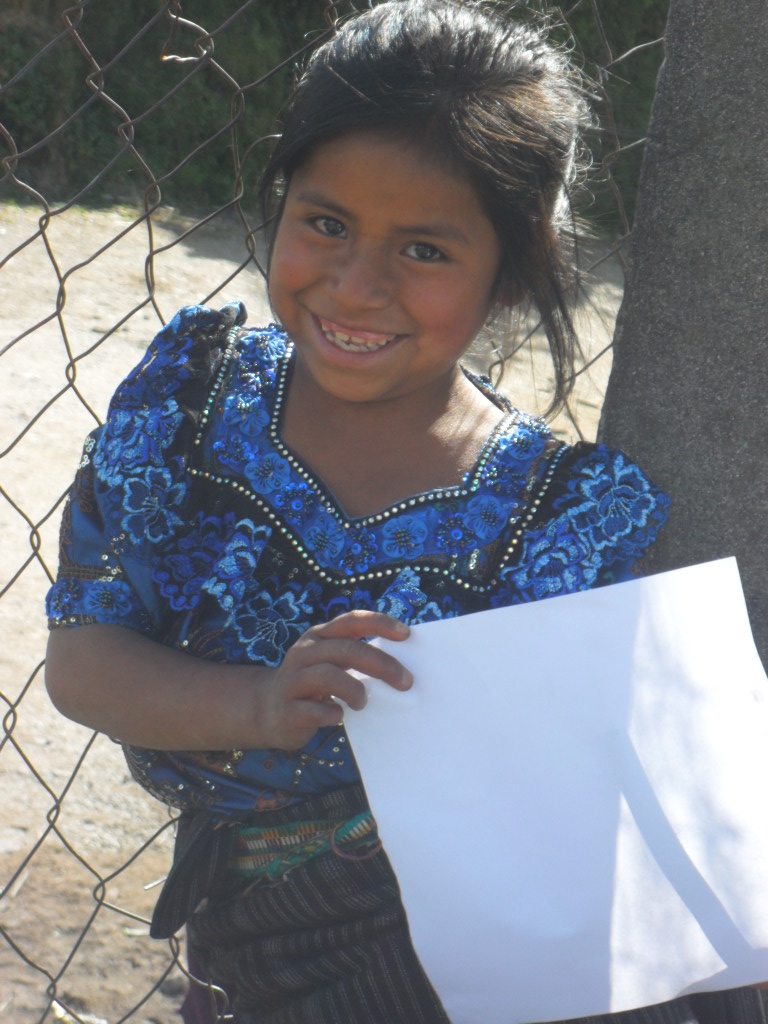
This past week Amy and I traveled to a school north of Nebaj in the Quiche region, near the Mexican border.  The school is called Neuvos Mayas, and was started 10 years ago by a Mayan family.  They lost parents, siblings and other relatives and friends during the civil war, and had to flee to the mountains to avoid being killed themselves.  They are rebuilding their lives in the region, focusing on their Mayan heritage and reaching out for support.  There are over a hundred students, and about a quarter of them live at the school.  The resilience of these people is extraordinary.  The children of all ages are warm, friendly, and joyful, and they are very enthusiastic about learning and participating in our activities.  One time Amy was in the middle of a circle activity with a class of teens, and the time for recess came.  Amy asked if they wanted to continue, and in unison they all shouted out “Si!”.  Would that happen in Canada?  I think not!  They are so appreciative and wonderful, it is an inspiration to me.  And though the school lacks most basic provisions (including trained teachers), once I let go of my “western” judgements I realize that they are a hundred times better off here than they were before the school existed.  They are learning!
Student of Nuevos Mayas
Yoga with Rosalie and Jacqueline - Neuvos Mayas

Spontaneous affection - Nuevos Mayas


On our way back to the lake we spent a night and morning in Chichicastenango, home to one the world's most amazing markets.  Here are some photos of our experience:
Amy negotiates at the Chichi market
Pig Market - Chichi


Incredible textiles - Chichi
My new "gorra" hat - Chichi


And finally, after five days of sometimes gruelling travel, we are back on the lake.  Ahhh... so beautiful and peaceful.  So nice to be here, with the knowledge that less than two weeks from now, we will start our journey north, and eventually get back to Canada.  I can't believe our time is almost over!

So the feelings are mixed, from the realization that things are really backward and limited, to the acknowledgement of the joy, energy and accomplishments of these amazing people.  I am so happy to have reconnected with this place after 37 years, and it feels like yet another home for me.  We will be back I’m sure!  There is more to do here.

Monday, January 30, 2012

Guatemala Ponderings


So many things happen every week, it’s hard to focus on one or two things to write about.  Amy said: “Start with a feeling, and then the details will come from there.”  Good advice, I think.  I do that often with writing songs and music, since for me, most of what I create musically is about capturing and communicating a feeling.  So…

What am I feeling?

I feel truly blessed to have the opportunity of spending some months in this glorious place, outside of San Marcos, Lake Atitlan, Guatemala.  I was here in 1975, and coming back feels a little like coming home.  Much has changed, but the feeling of this place still connects with my heart.

After the hot springs near Antigua
First of all, it is stunningly beautiful.  Nature abounds, from the volcanoes that surround this magical lake, to the abundance of flowers, birds and butterflies that are all around us.  Then there is the magic of Maya, the indigenous people of Guatemala, who have been here for thousands of years, in spite of all attempts to conquer, annihilate and assimilate them into whatever culture was prevailing.  From the conquistadors from Spain in the 1500’s to the Ladino conquerors of the last 50 years or so, who set out to “cleanse” the population, resulting in the deaths or disappearances of by some accounts more than 350,000 Mayan people, men women and children.  Every town and village has stories to tell of relatives who were murdered or “disappeared” by the military or by mercenary squads.  And yet the Mayan culture still exists, and is becoming stronger.  Some people say that Santiago Atitlan, which we can see from our front porch across the lake, is the largest indigenous cities (population 32,000) in the Americas.  We have yet to visit there, but it is definitely on our list!
Fire Ceremony

So my feelings are mixed.  In the midst of extraordinary beauty and amazing sweetness of the Mayan people here, this place is truly f*&#ed up!  The poor people (mostly indigenous) are more than poor.  They are often hungry, the kids have no shoes, and they are often without parents.  Education is a very low priority, and boys may go to school for only a couple of years before they are needed to help pick coffee or work with the rest of the family.  The illiteracy rate is the second highest in the hemisphere, and though many outsiders (i.e. gringos) and local Mayan leaders are lending support to building new schools, buying shoes and backpacks for poor kids so they can be allowed to go to school, and convincing the parents that the kids have to go (and keep going) to school, the problem is immense.  And, what is most disconcerting, the government does not seem to have the resources or will to focus funding and emphasis on improving education.

Also, like many developing countries, Guatemala doesn’t deal with garbage or sewage with any kind of effectiveness.  I have heard that there was a sewage treatment plant in Panajachel, the tourist centre of the lake, and after the last hurricane in 2005, it was destroyed.  In six years, they have not managed to rebuild it, so “black water” is flowing freely into the lake.  With the tourism industry being one of the main sources of money in the country (after agriculture), one would think the government would be more interested in fixing such a serious problem.  But nothing seems to be happening.

I believe there is a lot of corruption here.  Of course, there is corruption everywhere, even in our beloved Canada.  But here it is flagrant, obvious, and accepted.  For some reason, the government finds funds to pave a section of road (only a section mind you) outside of San Marcos, and erect a giant gate with a sculpture of a lion on top.  Very nice very nice.  But the roads in town are unpaved, the schools are suffering, and people are starving.  Why the fancy gate?  I can’t help but think it can only be a power play, rewarding some crony with money.  There is money, but how is it spent?

There was an election this year, and the government is changing.  Or is it?  The new president was a former general implicated in the massacres during the Civil War years of the 80s and 90s.  He was also the architect of the Peace Treaty that ended the war, so he has done some good things related to reconciliation.  But no matter who is elected, it seems that it is more of the same, the same people representing the same interests.  Guatemala is controlled by a very small oligarchy, and no matter who is elected, it doesn’t seem to change much.

Where I do see change and hope is in the efforts of the indigenous peoples, aided by some of us “gringos” and a few ladinos, to rebuild the Mayan society, to celebrate the richness and sacred traditions of the Maya, and most of all, to connect with the natural world, and to repair, rebuild, and generate the seeds of holistic, natural life.  Lots of permaculture, organic growing operations, efforts to protect the heritage seeds of the indigenous people, especially from threats from without, including multi-nationals like Monsanto (can they really be as evil as they seem?).  These initiatives are truly positive and inspiring, and there is lots of it.
Tata Pedro
And lastly, it is important to remember that life is fragile, here and everywhere.  There are frequent earthquakes, hurricanes, and mudslides during the rainy seasons.  The water level of the lake is rising a lot, destroying property along the shores.  Pollution continues to plague the lake, though it is possible to swim where we are (at the moment).  And poverty and illiteracy are two huge problems that never seem to go away.  Robberies and violence are very common, especially in Guatemala city, but even here in this most peaceful and beautiful environment, we are told not to walk alone on the roads at night, not to hike unless we’re in a group, not to carry valuables, and so on.  So there is that edge of fear that also exists here. We have personally experienced only friendly beautiful people, and we have had no problems.  Yet we are mindful of the dangers of this place.

I love it here, I love being here, and I am learning and experiencing new things every day.  It is a kind of paradise, in a way, but as we spend more time here, we also know that there are many serious problems, and that in some ways things are not okay.  Still, our lives are blessed, and we are trying to take advantage of these opportunities as best we can.  Thanks to God for all You provide!

Monday, January 16, 2012

Pasaj-Cap days


Well it’s been a while since I last posted.  It’s been an interesting couple of weeks.  Amy and I continue our explorations of Lake Atitlan, and especially the San Marcos area.  Josh is on his way to points south, and another friend arrives today for a week, staying in town.

We traveled to Guatemala City last Friday to spend our second Shabbat with the Casa Hillel community.  They are so wonderful, and we have established a mutual love affair.  This time we stayed with a family that moved to Guatemala from Colombia five years ago, and began the conversion process to Judaism while here.  Yakov is a dentist, and he has become quite knowledgeable, to the point of being the main prayer leader.  Raudith is an esthetician, who has set up shop in their home.  They have three teenage children, two girls 19 and 17 and a boy 15.  They insisted on vacating the “master bedroom” so Amy and I could sleep there.  They speak little English, so we got to practice our limited Spanish a lot!  It is coming along, though it can be a struggle sometimes.  Actually it turns out that all three kids are learning English in school, so they were holding out on us!  Nevertheless, it’s important for us to be forced to speak Spanish.


I helped lead services, brought my guitar to share some songs and prayers.  Some they already knew, though not well, so I was able to enhance their knowledge of those.  Others were brand new, and we learned and then sang them together.  I was also able to chant some of the Torah portion from the scroll, which they are not used to doing, so that was a nice addition to their ritual experience.  After services, we shared lunch together, and then Amy went to work with the “kids” teaching them basic Hebrew reading skills, and beginning to prepare Ardany for his becoming Bar Mitzvah next November.  The teenagers are very enthusiastic and appreciative, as Amy weaved her magic with them.  I took a nap in the back room on an air mattress (well it was Shabbat after all!).

Life in Guatemala is complicated.  There is so much joy, and yet it is usually fraught with challenges and difficulties.  The day before our arrival, thieves ripped the water metre off the outside wall of the Casa Hillel house, so there was no running water or toilet available for the weekend.  We brought in big bottles of purified water, but we were limited in our water use.  So in the afternoon, Amy suggested we go for ice cream (and to use the Baños!).  We ended up at a large mall nearby.  It was packed with people!  This is life and entertainment for many in the big city.  Kind of crazy!

We returned to the Lake on Sunday with our friends Clayton and Rosalie (Maalaa) from Gabriola.  Rosalie arrived early Sunday morning, so we shared a ride with them and the wonderful driver Chema.  When I got back, I crashed!  Maybe I picked up something in the city, maybe I was exhausted, but I really had no energy and didn’t feel well.  Whatever it was passed through me over the next three days or so, and I felt myself gradually improving each day.  I feel much better now, though I have started taking some remedies to help keep my system free of unwanted “guests”.  So far so good…

When we are here, we have a wonderful routine of waking up around 7:30, making coffee and taking it slowly till about 9.  Then Yoga, meditation, then breakfast.  We have Internet here, so there is correspondence and computer “work” that we generally do in the morning.  My current activities include sending out applications to perform at music festivals in B.C. this summer, recording some songs and prayers to send to Casa Hillel so they can practice when we’re not there.  There are also “giglets” and other musical events happening here that I get involved with.  We are planning some hikes building up to the big one, climbing Volcano San Pedro.  We are also planning some trips to other villages around the lake, time in Antigua, and other explorations in this area.  We are busy and productive, with enough time to just be.  It’s a good balance for us, and I highly recommend it to anyone who can manage it!

We have been enjoying some of the local music scene over the past few days.   On Friday night we went to Ganesh, a nice restaurant performance space in town, and saw two Norwegian young women who sang sweet harmonies together, accompanied by Meaghan on violin. They accompanied a magican who did a climbing show on sheets tied to the high ceiling, followed by a magic/comedy set.  They ended early (around 9) so we headed to another spot in town called Blind Lemon’s, where Carlos, an American who has been connected to San Marcos for many years, held forth with his wonderful blues guitar and singing with vintage instruments including a National Steel Guitar, a parlour acoustic and another slide guitar.  Then last night (Saturday) we went to another musical show with Sativo, a local hip-hop artist who sings mostly in Spanish accompanied by acoustic guitar and beats using his mouth.  He incorporated others into his performance, including another rapper from Cuba, a young woman rapper/singer from Costa Rica and local man who rapped in the indigenous Kaqchikel language – that was a first!  Then he invited some of the local boys to breakdance.  It was an international hip-hop fest, and though I couldn’t understand many of the lyrics (which of course is the key to hip-hop/rap music), it was still very enjoyable and energetic, with lots of people dancing and partying.  A good night!
Sativo at Ganesh
I notice that time is flying by.  We will have been here on the lake for a month on Sunday, which seems incredible to me.  We are loving being here, and there’s lots to do before our time comes to depart.  So I’d better get busy now!


Sunday, January 1, 2012

New Year’s Eve on Lake Atitlan


The Lake
What a magical place to be for New Year’s!  Josh Amy and I are here in our beautiful place at Pasaj-Cap, a fifteen minute to San Marcos.  Here is what my New Year’s Eve day shaped up to be:

I woke up around 7 or 7:30.  It’s hard to sleep when the sun comes up and illuminates Volcano San Pedro which faces are big window.  It’s better to get up!  We drank coffee, checked email, hung out for a little bit enjoying our surroundings.  Then I went up to our roof where there is a little palapa with hammock and some lounge chairs.  There is a shady spot up there, and I lay out my yoga mat and started a short yoga routine.  I heard a little explosion, and saw a puff of smoke in the distance, emerging from Volcano Fuego which is towards Antigua.  Okay, carry on with sun (and volcano) salutations.  I am struck by the power and magic of my surroundings on a regular basis.  The lake is always changing, it seems like it is different every moment.  The light and shadow changes, the wind rises and falls, sometimes it is calm, sometimes the lake is filled with whitecaps.  There are many villages visible around the circumference of the lake.

I was starting to wrap up my little practice and prepare to sit for 10 minutes, when Amy came up and was clearly upset.  “What’s wrong?” I asked.  “I must have left my iPhone at Del Lago last night.  It’s gone!”

So instead of sitting, we walked to town, about 20 minutes away.  There was upsetness happening, and I reminded Amy to just look around, or, as is my mantra when we travel: “Look where we are!”  The rough dirt road to town, is absolutely stunning, with tons of trees of all kinds, flowers, birds, and of course, the lake.

Del Lago is the name of the Hostalito/Restaurant we discovered immediately upon our arrival in San Marcos.  We tend to be drawn there for many reasons.  One reason is our Spanish teacher, Andres (Andrew).  Andrew is originally from Brooklyn, and was teaching Spanish to middle school students there for a few years.  He decided to step away from the “system” and come to Guatemala to see how he could apply his skills and knowledge to make a difference here.  He is 27 years old, and we have become good friends.  He also happens to be a wonderful Spanish teacher, and both Amy and I are working hard and making progress.
Amy and Amir in the communal kitchen at Del Lago


Anyhow, we started asking around, and when we asked Steve, who is kind of the manager of the place, he pulled Amy’s iPhone out of his pocket and said someone found it and handed it to him.  What a relief!

So in a much happier space, we grabbed Andres and took him out for breakfast at his favourite little Libreria/Restaurant called “Iris” near Del Lago.  Breakfast costs around $3 for a full meal with coffee and juice, and we spent some valuable time with Andres helping him process a difficult situation he was going through.  An hour or more later (Guatemalan time!) we strolled back home to join Josh.

Our “landlord” Pierre hosted a party here down by the lakeshore on the property in the afternoon for guests and friends from around San Marcos.  It was well underway when we arrived (around 2 pm).  There was a pile of fire roasted chicken, salads, including a broccoli salad we brought, mojitos and wine and beer.  There was a “weed” circle nearby as well.  Recorded dance music was playing, and around 30 people were there.  Josh and I played a few tunes on guitar and charrango, then the dance music came on again.  It was a nice party, and I met around 10 new people, some who were staying on the property, and some who live nearby.  It is a really interesting group of people from all over the world: France, Belgium, Germany, Canada, U.S., Sri Lanka, and more.  One intense thing that happened was the Sri Lankan man collapsed and needed some urgent medical care, with concerns about his heart rate.  One guest from Canada (also named Paul) is a psychiatrist, and he was able to help stabilize the man.  Finally Josh helped translate from English to Spanish, and the man was carried to a waiting truck for transport home.  It definitely affected the mood of the party, and was a reminder of the fragility of our lives, especially in a remote environment like this one.

We left the party around 5 pm, and rested in our apartment for a couple of hours.  Ahhh – quiet time!  Then the three of us walked into town to Restaurant Fé (which means faith in Spanish).   Again, the road is always magical and changing.  Last night there was a big circle around the almost half moon, guiding our way along the road.  Our Israeli friend Uria was performing on guitar and vocals for the evening, and Josh and a violin player named Jorge joined him.  I also joined on guitar for a couple of long songs.  We had a nice dinner (vegetarian Kashmir curry and Palak Paneer, Josh had chicken Biryani).  We spent some time hanging out with Uria’s partner Titeli (butterfly in Sanskrit, and when she danced to the music we could understand why that was her name), sleeping baby Ariel, who will turn two on January 9.  Ariel is a very special child, born exactly 30 years to the day after Josh.  They have a connection!  The family is traveling with Uria’s mother Tziona, and will spend a couple of months together in Hawaii, there next destination.  Lucky Mom!  So after more music, conversation, food and beverages, things wrapped up around 10 pm. How nice and early!  We grabbed a tuk-tuk (rickshaw) ride home, and actually went to bed around 11 pm.

We were awoken by the sounds of fireworks.  We got up and went to the window.  I wish we could capture what we saw in a photo - it would have to be a panoramic shot.  We can see almost all the way around the lake, and we could see bright colours flashing in around 8 different places, 8 different villages.  It lasted for more than half and hour, and we just observed from our little apartment fiery colours miles away.  It was quite amazing!

And so we had a very rich and full day to welcome in 2012.  Of course 2012 is a most significant year in the Mayan calendar, and it seems so fitting that we bring in 2012 here on Lake Atitlan!  I have a feeling that this year will be another adventurous one for us!  Hang on to our hats!

Hoping anyone reading this post also enjoyed a great New Year’s Eve, and wishing a good year to all!

Thursday, December 29, 2011

Casa Hillel


Okay Casa Hillel.  It’s hard to describe, but it is wonderful to be there!

It starts with two people.  Both man and wife grow up in a Catholic environment, never feeling comfortable or at home with the Church.  They both were searching for a spiritual path that was real to them, and they discovered a deep resonance with progressive Judaism.  They began to reach out to see if there were others “out there” who felt the same way.  Eventually a Reform Rabbi from the United States contacted them and agreed to help them develop a Jewish life and community.  They began the conversion program with this man, and others came and sought conversion as well.  The community is made up of around thirty souls, twenty adults, and ten youngsters from two months to nineteen years old.
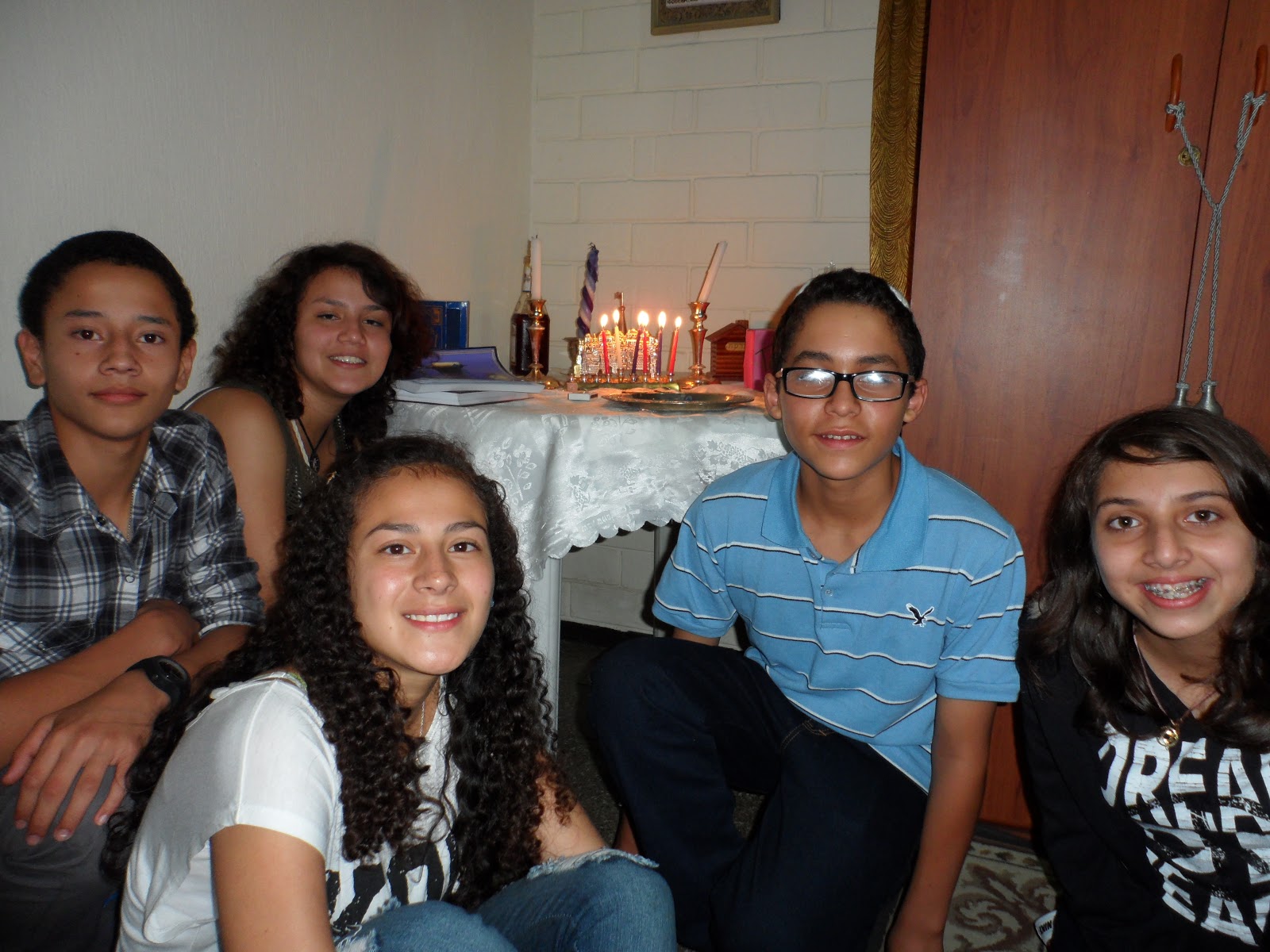
Los Ninos with Chanukah candles

The first thing that strikes me when I meet these people to welcome the Shabbat on Friday night, is the positive energy they exude.  The teenagers in particular are amazing, kissing the mezuzah with reverence as they enter the modest house that serves as synagogue, and participating with energy and enthusiasm in all the rituals, songs, games and learning.  We lit the Chanukah candles, sang songs together, some that we brought, some that they knew, including a couple of Ladino songs, and some we knew together.  Then we lit Shabbat candles, said some more prayers, a short kiddush, motzi and we sat down to a dinner all together.  Then more songs and games of dreydl all around.  There was one table of adults – at least 8 people – and a table of youngsters – around 10, all playing and laughing and enjoying the holiday and each other.  It was such a joy!

Shabbat Services
Amy sharing
These people have so little, and are so rich in spirit.  They struggle to be accepted by the mainstream Jewish community in Guatemala, with almost no success.  There are some members of those communities who are friends and who come, but they are shunned by most because they say they are not really Jewish, the conversion was not “real”, and so on.  They are in the process of reaching out to the Reform Jewish community of all of Latin America, and may soon become a recognized Reform congregation representing the Reform movement in Guatemala. 

They have a lot to learn.  We are starting to help teach them Hebrew, more prayers for Shabbat, Torah portions, and so on.  They are open and receptive, and have put together their own Siddur with Hebrew, Spanish and transliteration.  They are leading services every Shabbat morning, have a Torah, an ark and a Torah table.  We spent the whole day together on Shabbat, arriving around 10 am, and not leaving until after Havdalah and food around 9 pm.  Two month old Sarita is the centre of attention, and a baby-naming with “Rabina Elyse” is upcoming.  They adore Rabbi Elyse Goldstein and are so grateful for the way she has embraced them over the past six months.  And Ardany will celebrate his Bar Mitzvah in November 2012, and we are trying to help him prepare for that.
Havdalah 

We are so thankful for the opportunity of experiencing this wonderful community, and look forward to spending more Shabbatot with them over the next couple of months.